
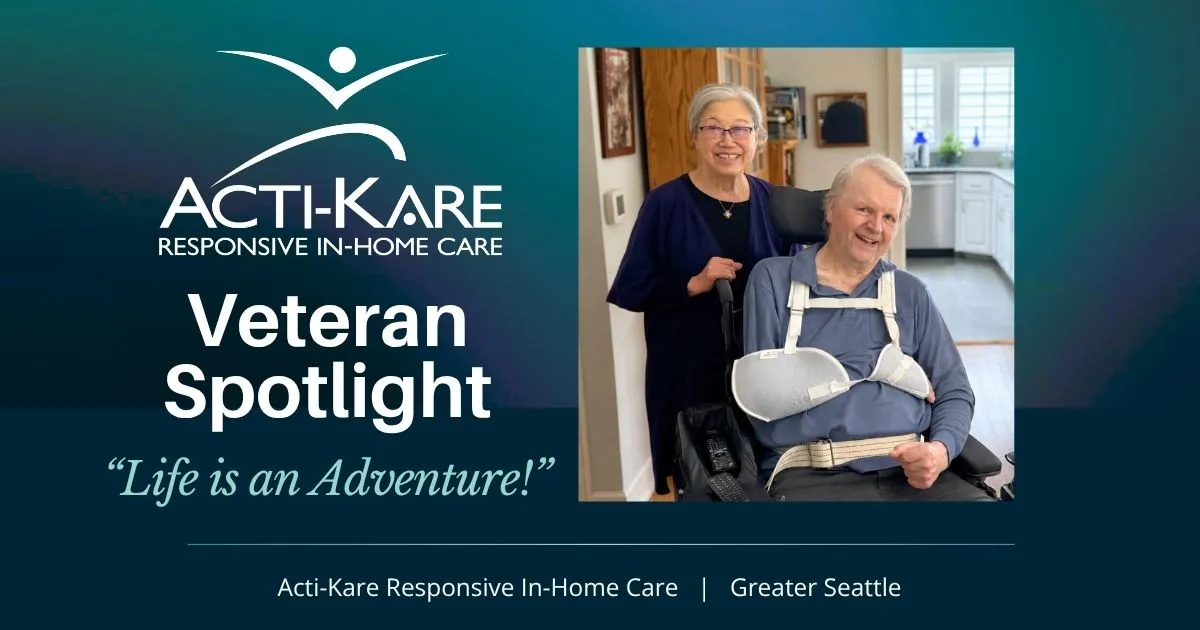
At Acti-Kare Responsive In-Home Care, we are honored to support veterans across King, Snohomish, and Pierce Counties through the VA’s Home Health Aide program. This is Jeffery’s story, told in his own words during a visit to his Seattle home in May 2026.
When you sit down with Jeffery, you should know going in that you will not be leaving soon. Not because he needs anything from you. Because he has things to tell you.
He will tell you about the right way to build garden soil (hairy vetch in late August, then fallen leaves, then let the worms do their work). About a hidden motel on the Oregon coast where you can buy a live crab next door and cook it yourself. About the powder skiing in Whitefish, Montana, where he says you will feel like a completely different person on skis.
He is in his 70s, writing his memoir by hand, and by his own account he is only in first grade.
“Life is an adventure,” he says, grinning. It is both his motto and his biography.
From the Lottery to the Gun Line: Jeffery’s Vietnam-Era Service
Jeffery grew up outside Philadelphia and graduated from college in 1970, right as the Vietnam-era draft lottery was heating up. His number came up 13. He knew what that meant.
A friend suggested he join the naval reserve, and Jeffery took the advice. A recruiter steered him away from the medical corps and into radar school instead. After six months of training in North Chicago, Jeffery was handed a card asking whether he preferred the East Coast or the West Coast. His friend from New Jersey made a compelling case for San Diego. They both signed up for destroyers.
“I was a round peg in a square hole on the East Coast,” he says. “When I got to California, I was like, oh yeah. This is where I’m supposed to be.”
His ship was a destroyer built at the end of World War II and homeported in Yokosuka, Japan. Their job off the coast of Vietnam was naval gunfire support: a Marine in a light plane overhead would radio coordinates, the ship’s guns would fire, and the spotter would call corrections until they were on target. The ship spent six to eight months in the battle area. Jeffery is quick to note with a laugh that he was well fed and sleeping in a bunk while the men on the ground had it far worse. “Three squares and a flop,” he says.
What stayed with him most was not the mission. It was the captain. “I never thought in my life I would meet somebody who was so together, such a great person — if he had said the crew needed you to step up, I would have believed this man completely,” he says. “We would have done anything for him.”
Yokosuka, Yoshi, and a Few Years on the Road
The Navy got Jeffery to Japan, and Japan gave him something he did not expect. His father had business contacts in Tokyo and suggested Jeffery look them up. He did. One of the contacts had a secretary named Yoshi. They have been together ever since.
After his discharge, Jeffery bought a used Honda motorcycle and spent a couple of months riding up around Vancouver Island, down the Pacific Coast, and all the way home to Pennsylvania in time for Christmas. He already knew he wanted to come back to the Pacific Northwest. But first, he and Yoshi had a world to see.
They spent three and a half years traveling overland together — trekking the Himalayas in Nepal, working their way across India, then flying to Nairobi to join a truck traveling south through Africa toward Cape Town. They learned some Nepali. They stayed in hotels that had, as Jeffery puts it, a great deal of character. They saw things most people only read about. Eventually they made their way back to Japan, worked for a while, and when Yoshi was expecting they decided it was time to go home. They landed in San Francisco. Jeffery enrolled in nursing school.
The Doctor Who Started Medical School at 40
After a couple of years as a nurse, Jeffery set his sights higher. He got letters of recommendation from physician colleagues, wrote a memorable application essay, and got in. He was 40 years old when he started medical school at UC Irvine.
After residency, Seattle kept calling. He came north, bought a house built in 1939 with a massive cedar tree out front that he has fed for decades by rerouting the roof’s rain gutters to its base, and he and Yoshi built a family practice together. Yoshi ran the front office. Their daughter, who also went into medicine, eventually joined them in the back. Jeffery practiced family medicine for over two decades, and along the way developed what he calls cinema therapy: when a patient was grieving or struggling in a way that talk alone could not touch, he prescribed a film. He still maintains a curated list and hands it out freely.
Around the year 2000, Jeffery noticed he was losing energy and struggling on hills during his mountain bike rides. A cardiologist found a blocked artery. Before the scheduled procedure, Jeffery came across the work of Dr. Caldwell Esselstyn, a physician who had reversed advanced heart disease in terminal patients through a strict plant-based diet: no meat, no dairy, no oil of any kind. Jeffery, the doctor, did his research and believed it. He and Yoshi changed how they eat entirely and have stuck with it for more than twenty years. His heart is fine. His brother on the East Coast, who was failing a five-way bypass, reluctantly followed the same advice and turned things around too.
“This saved my family,” Jeffery says. “This saved my patients.”
Jeffery’s Heart-Healthy 3-2-1 Salad Dressing
3 parts balsamic vinegar, 2 parts mustard, 1 part maple syrup
Whisk together and dress your salad. “Everybody likes it,” they promised.
They retired in the mid-2010s. Jeffery was healthy and active. Then, in 2019, a sledding run a couple of blocks from home ended badly.
The Accident, the VA, and Coming Home
The injury put Jeffery at Harborview Medical Center for six weeks, and then at the VA Puget Sound Health Care System for five months of inpatient rehabilitation.
“They taught me to walk again over there,” he says of the VA.
He came home to a power wheelchair and a significantly different daily life. Yoshi became his primary support, as she has been through everything. Their daughter FaceTimes every single day from London, where she lives with her English husband and their two grandchildren. And through the VA’s Home Health Aide program, a caregiver began coming to the house on a regular schedule. That caregiver has become a real part of the daily rhythm.
What In-Home Care Actually Looks Like Day to Day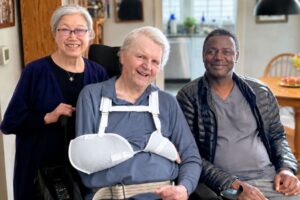
For veterans and families weighing whether in-home care is the right step, Jeffery’s situation offers a clear picture of what it can look like in practice.
His caregiver helps with the physical tasks that carry real safety risk: getting Jeffery up from his chair, assisting with transfers to the bathroom, and accompanying him on his indoor walking practice. “My caregiver gets me up,” Jeffery says. “He’ll say, ‘Hey, it’s time for us to walk again,’ and he’ll get my butt up and take me safely to the kitchen. We’ll turn around, look at the garden, and come back.”
On good days that walk extends outside. Jeffery works his way around the neighborhood under his own power, with his caregiver alongside. They also get out together on an adaptive trike, covering as much ground as the weather and Jeffery’s energy allow.
“You’re chatting with your crew, looking at things, talking to people, seeing dogs,” Jeffery says. “The neighborhoods around here are really nice.”
This kind of daily movement matters more than it might appear. For someone in Jeffery’s situation, consistent mobility support helps maintain strength, reduces fall risk, and supports overall physical function. Staying in motion, even in a more limited way than before, is not just quality of life. It is health care. And as a physician, Jeffery is clear-eyed about that distinction.
The Support Behind the Support
Something that often goes unspoken in conversations about in-home care is what it means for the family member who is already carrying the most.
Yoshi is, by Jeffery’s own description, the reason he is doing as well as he is. She is his constant, the person who has been beside him through decades of adventure and now through this. But caregiving at home is physically and emotionally demanding, and having a trained professional share that responsibility is not just a convenience. It is what makes the whole arrangement sustainable.
When Jeffery’s caregiver is there, Yoshi has time to step away and tend to her own needs. Transfers that might put her at risk of injury are handled safely by someone trained for exactly that. And when Jeffery is ready to get outside, there is someone with the energy and skill to make it happen.
This is one of the most consistent things we hear from families: the relief is not only for the person receiving care. It is for everyone around them.
“That’s what’s keeping me alive,” Jeffery says. “This lady. My caregiver. The grandkids. And writing down all the stuff we’ve done — and I’m only in first grade.”
For Veterans and Families Considering In-Home Care
Acti-Kare Responsive In-Home Care is a VA-credentialed home care agency that has been serving veterans and their families across the greater Seattle area for over a decade. We work directly with VA social workers and care coordinators to support veterans through the Homemaker Home Health Aide program, and we also provide private-pay care for families who need more hours than the VA authorizes. We are proud recipients of the 2025 Seattle Times Best in the Pacific Northwest for Home Care, and seven consecutive Caring.com Super Star Awards.
Frequently Asked Questions
What is the VA Home Health Aide (HHA) program?
The VA Home Health Aide program provides in-home personal care support to eligible veterans, allowing them to live safely and independently at home rather than in a care facility. Through this program, the VA contracts with credentialed community agencies to deliver services including help with bathing, dressing, mobility assistance, and other daily activities. Veterans must be enrolled in VA health care and meet eligibility criteria based on their service-connected disability or clinical need. Download our free guide to VA home care in Washington State to learn more about how the program works and how to get started.
Does the VA pay for in-home care for veterans?
Yes, eligible veterans can receive in-home care at little or no out-of-pocket cost through VA programs including the Home Health Aide program and the Aid and Attendance benefit. Coverage depends on the veteran’s disability rating, clinical need, and enrollment status in VA health care. A VA social worker or care coordinator can assess eligibility and authorize a specific number of care hours per week.
How does a veteran qualify for home care through the VA in Washington State?
Veterans enrolled in VA health care who have a service-connected disability or a clinical need for personal care assistance may qualify for home-based services in Washington State. The process typically begins with a referral from a VA physician or social worker, who assesses the veteran’s needs and authorizes hours of care. Veterans in King, Snohomish, and Pierce Counties can be connected with VA-credentialed local agencies through the VA Puget Sound Health Care System.
What does a VA-credentialed home care agency do?
A VA-credentialed home care agency has met the VA’s standards for quality and compliance, allowing it to provide authorized care to veterans through VA Community Care contracts. Caregivers assist with activities of daily living such as bathing, dressing, grooming, meal preparation, mobility support, and companionship. Acti-Kare Responsive In-Home Care is a VA-credentialed agency serving veterans across King, Snohomish, and Pierce Counties in Washington State.
Can a veteran stay at home instead of moving to a nursing facility with VA support?
In many cases, yes. The VA’s home-based care programs are specifically designed to help veterans remain safely in their own homes. With the right level of in-home support, many veterans with significant disabilities can continue living at home with family rather than transitioning to assisted living or skilled nursing facilities. A VA social worker can assess whether home care is a clinically appropriate alternative for a specific veteran’s situation.
What is the difference between VA home health care and private in-home care?
VA home health care is funded through the veteran’s VA benefits and authorized by the VA care team, with no out-of-pocket cost to eligible veterans. Private in-home care is paid for directly by the individual or family, through long-term care insurance, or other personal funding. Some veterans use both: VA-authorized care for a set number of weekly hours, supplemented by private-pay care for additional coverage. Acti-Kare provides both VA-authorized and private-pay in-home care across the greater Seattle area.
How do I get started with VA in-home care for a veteran in the Seattle area?
The first step is to contact the veteran’s VA care team or social worker and request an assessment for home-based care services. Veterans served by the VA Puget Sound Health Care System can be connected with community agencies in King, Snohomish, and Pierce Counties. Family members and social workers can also call Acti-Kare directly to ask questions about what the process looks like. Download our free guide to VA home care in Washington State for a full overview of eligibility, authorization, and what to expect.