
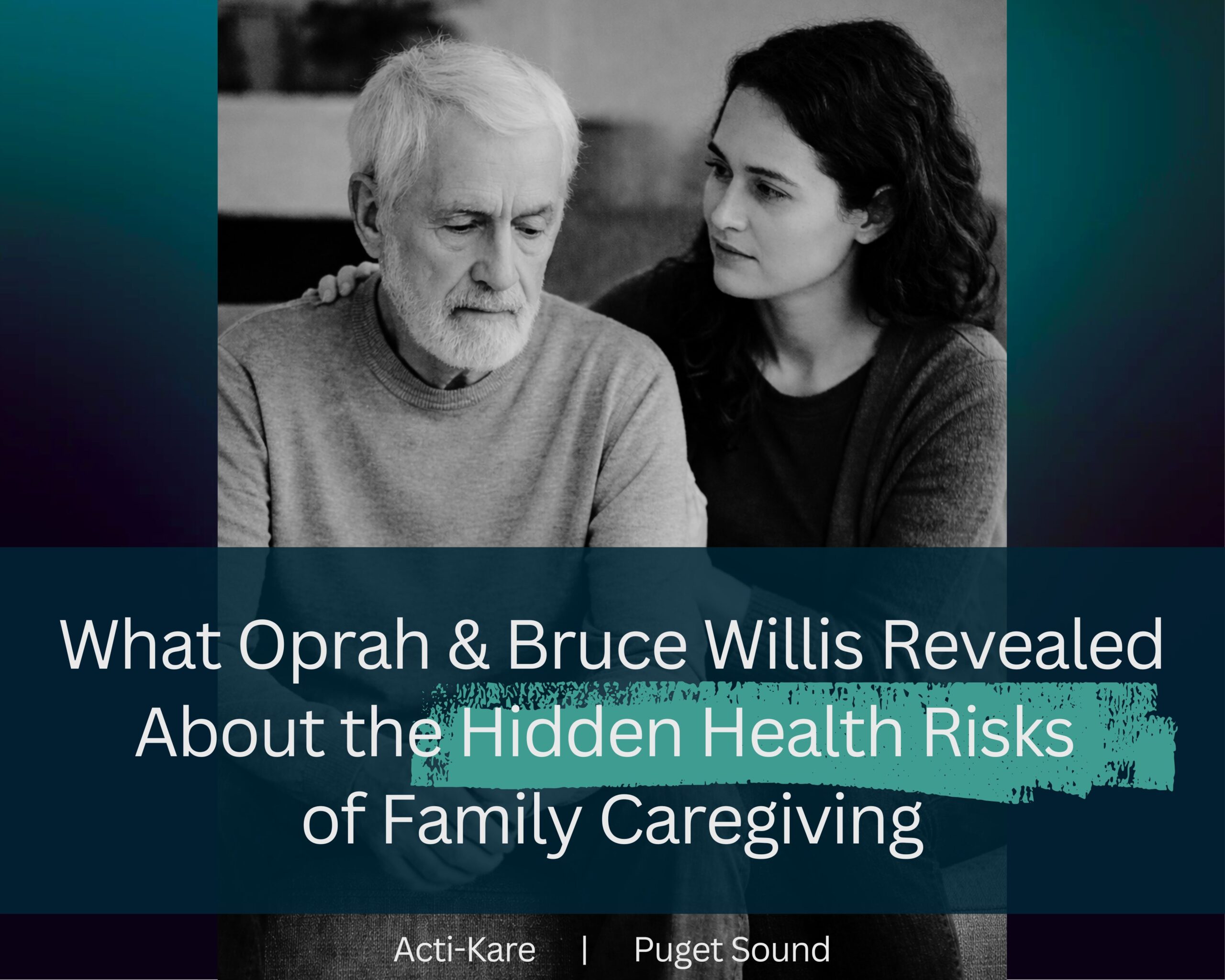
I was halfway through an episode of Oprah’s podcast when Emma Heming Willis began talking about caring for Bruce after his frontotemporal dementia diagnosis, and I had one of those moments where you stop what you’re doing and just listen.
As she described her life as a dementia caregiver, it felt uncomfortably familiar. Not because it was celebrity-driven, but because it mirrored the quiet stress I see every day in families caring for aging parents. The constant responsibility. The vigilance that never really shuts off. The slow erosion of your own health until, as the research shows, the impact is undeniable: caregivers who carry the load alone face real, measurable health risks — including shorter lifespans.
You can watch the full conversation here on YouTube: https://www.youtube.com/watch?v=RMdp8Hh5Bks
Or listen to it on Oprah’s podcast here: https://podcasts.apple.com/us/podcast/oprah-and-emma-heming-willis-on-caregiving/id1782960381
There Is No Roadmap for Caregiving
One of the clearest themes in Oprah’s conversation with Emma is that no one hands caregivers a roadmap, especially when dementia is involved.
Early symptoms are subtle. Changes are confusing. What feels like stress, aging, or personality shifts slowly reveals itself as neurological disease. Emma spoke openly about how long it took to understand what was really happening — and how unprepared she felt once the reality became clear.
That lack of clarity is something families across the Puget Sound region describe all the time. Caregiving doesn’t start with a clear beginning. It starts with unease. A sense that something isn’t right, but not enough information to act decisively.
And because there’s no roadmap, people wait.
Most Adult Children Don’t Realize They’ve Become Caregivers
Most adult children don’t think of themselves as caregivers. They think they’re just helping — checking in more often, managing appointments, keeping an eye on medications, answering late-night phone calls.
Until suddenly, they’re exhausted.
This gradual escalation is common, and it’s part of why caregiver stress often goes unnoticed until it becomes overwhelming. By the time many caregivers recognize the toll, they’ve already been operating under sustained stress for months or years.
The Science Is Clear: Caregiving Stress Impacts Health and Longevity
Caregiving has been studied extensively as a form of chronic stress, and the findings are consistent across decades of research.
- A large review published in Psychological Bulletin describes family caregiving as involving long-term psychological strain, unpredictability, and sustained vigilance — all conditions linked to stress-related health outcomes: https://pmc.ncbi.nlm.nih.gov/articles/PMC2791523/
- One of the most cited studies in this area, published in JAMA, found that older adults providing care while experiencing emotional strain had a higher risk of mortality compared to non-caregivers facing similar circumstances: https://pubmed.ncbi.nlm.nih.gov/10605972/
- The American Psychological Association also summarizes evidence showing caregivers are more likely to experience depression, anxiety, and physical health problems than non-caregivers: https://www.apa.org/pi/about/publications/caregivers/faq/health-effects
These studies don’t suggest that caregiving is inherently harmful. They show that caregiving without adequate support can place caregivers at risk, especially when stress is prolonged and without relief.
Caregiver Self-Care Isn’t Optional — It’s Protective
One of the most striking elements of Emma Heming Willis’s story is her acknowledgment that she ignored her own needs early in the caregiving journey — and how costly that became.
In interviews with AARP, she has spoken about learning that caring for herself wasn’t indulgent, but necessary in order to continue caring for her family: https://www.aarp.org/caregiving/life-balance/emma-heming-willis-interview/
Self-care in this context doesn’t mean stepping away emotionally. It means protecting sleep, physical health, mental health, and personal boundaries so caregiving doesn’t consume everything else.
The Grief No One Talks About: Ambiguous Loss
Emma’s conversation also touched on a kind of grief many caregivers experience but rarely name: grieving the changes in someone you love while they are still physically present.
This is often referred to as ambiguous loss, a concept frequently discussed in dementia caregiving. The Association for Frontotemporal Degeneration describes how this ongoing grief contributes to emotional exhaustion and caregiver burnout: https://www.theaftd.org/posts/front-page/emma-heming-willis-shares-family-updates-on-the-oprah-podcast/
This grief doesn’t come with closure. It accumulates quietly, often alongside guilt and fatigue.
Why Waiting for a Crisis Makes Everything Harder
Another consistent message from Emma’s story is that families often wait until crisis before seeking help.
Early signs are easy to rationalize. Safety concerns don’t feel urgent — until they are. By the time families reach out for support, caregivers are often depleted and reactive rather than thoughtful and proactive.
Early support doesn’t mean giving up. It means planning while you still have capacity.
Caregiving Works Better as a Team
One of the most practical lessons from Emma’s journey is that caregiving works best when it’s shared.
Professional caregivers, respite support, and community resources reduce emergencies and protect caregiver health. This isn’t about replacing family. It’s about preserving it.
AARP emphasizes that sustainable caregiving requires systems of support, not heroics: https://www.aarp.org/caregiving/life-balance/emma-heming-willis-interview/
Caregiving isn’t meant to be a solo act.
The Guide Emma Wishes She Had At The Beginning
Emma Heming Willis has said her book, The Unexpected Journey: Finding Strength, Hope, and Yourself on the Caregiving Path, is the guide she wishes she had at the beginning.
That timing matters. Caregivers don’t just need inspiration. They need validation, information, and practical guidance — before burnout hits.
The larger message of both the book and the Oprah conversation is simple and powerful: caregivers deserve care too.
What I Want Puget Sound Families to Hear
Caregiving without support is a health risk.
Waiting doesn’t make it easier.
Asking for help isn’t failure — it’s foresight.
You don’t need to do everything yourself to be a good daughter, son, or partner. In fact, trying to do it all alone may cost more than you realize.
Caregiving is not meant to be carried alone.
Frequently Asked Questions About Caregiver Support
How do I know when it’s time to bring in home care?
If caregiving is affecting your sleep, work, health, or emotional well-being — or if your parent’s needs are increasing — it’s time to explore support.
Can we start with just a few hours of care?
Yes. Many families begin with limited hours for companionship, safety checks, or personal care and increase support gradually.
Will my parent resist having a caregiver?
That’s common. A gradual, respectful introduction usually helps. The right caregiver often makes a significant difference.
Does home care replace my role as a family member?
No. It allows you to step out of constant task management and return to being a daughter, son, or partner again.
Why is caregiver health so important?
Because caregiver stress is linked to real medical risks, including chronic illness and shorter lifespan. Protecting the caregiver protects everyone.